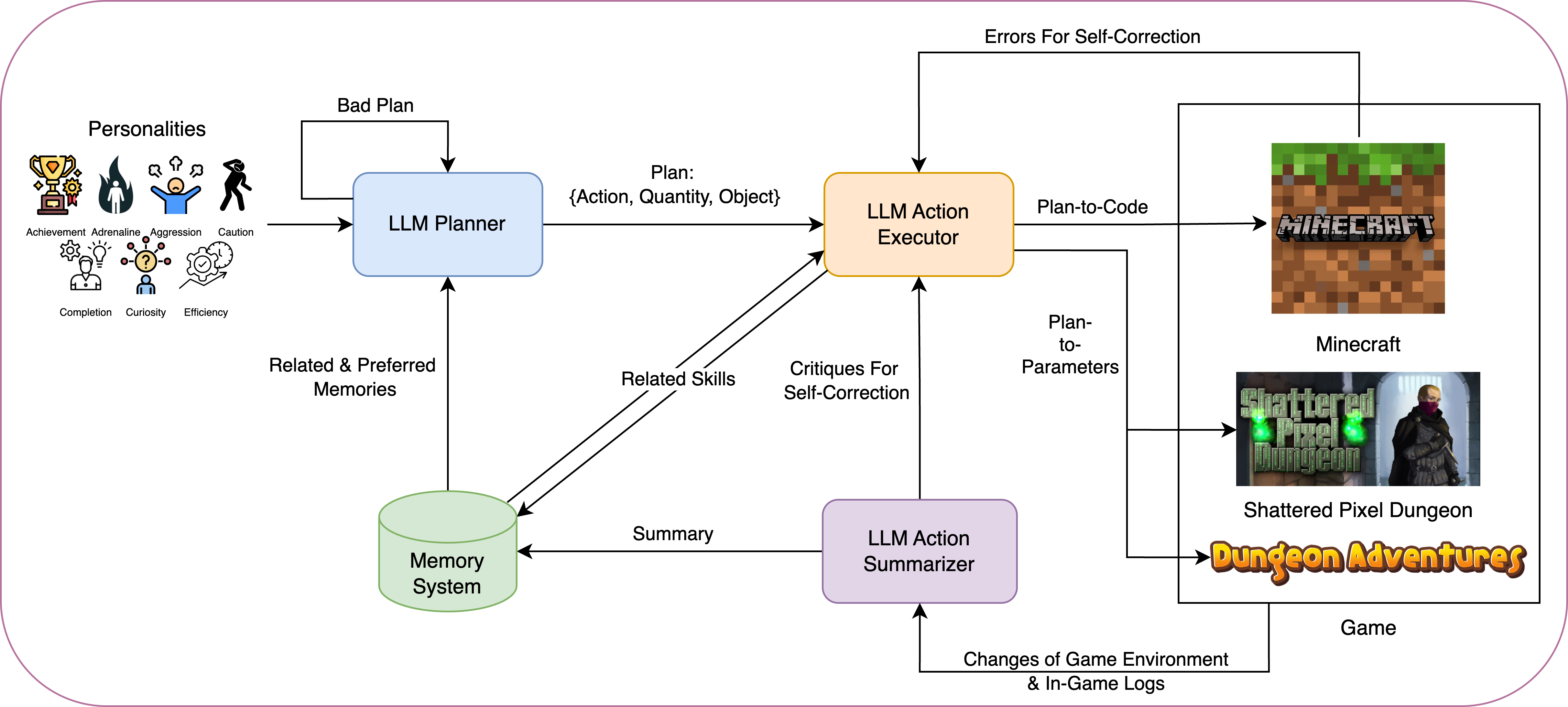
Personality Trait Definitions from PathOS
Personality Trait Definitions
| Personality Trait | Description |
|---|---|
| Curiosity | Drive to explore the extents of the game world; particularly drawn to POIs and NPCs |
| Achievement | Desire to earn game achievements and accomplish feats of skill, endurance, or luck; drawn to goals and collectibles |
| Completion | Motivation to finish a game "100%", completing every checkbox along the way; drawn to most interactive objects |
| Aggression | Wanting to exert dominance over the game world and seek out combat; particularly drawn to enemies |
| Adrenaline | Seeking the thrill of challenge, looking to take risks; particularly drawn to environmental hazards and enemies |
| Caution | Averse to danger; repelled by hazards, drawn to survival resources |
| Efficiency | Desire to meet end objectives as quickly as possible; particularly drawn to mandatory and final goals |
Samantha Stahlke, Atiya Nova, and Pejman Mirza-Babaei. 2020. Artificial Players
in the Design Process: Developing an Automated Testing Tool for Game Level and
World Design. In Proceedings of the Annual Symposium on Computer-Human Inter-
action in Play (Virtual Event, Canada) (CHI PLAY ’20). Association for Computing
Machinery, New York, NY, USA, 267–280. doi:10.1145/3410404.3414249
In-Game Elements / Entity Types
| Element Name | Description | Refer to... |
|---|---|---|
| Optional Goal | Objective marker not necessary for level completion (e.g., sidequest mission markers, optional puzzles) | Objective, optional goal, goal point |
| Mandatory Goal | Objective marker necessary for level completion (e.g., main mission marker) | Objective, committed goal, goal point |
| Final Goal | Objective which triggers the end of a given level | Objective, outcome |
| Enemy Hazard | A hostile character, etc. which could incite combat | Enemies, agents, combat |
| Environment Hazard | Physical hazard which could damage the player | Deadly traps, obstacles |
| Survival Resource | Item which can be picked up for some benefit to player survival, such as health packs | Resource, power-up, resource |
| Collectible | Item which can be picked up to contribute to achievements or unlocking content | Resource, objective, collecting, pick-ups |
| Point-of-Interest (POI) | Environmental feature, landmark, or setpiece intended to capture players’ visual interest | Exploration |
| Non-Player Character (NPC) | Non-hostile character who may be interacted with for story purposes, completing a mission, etc. | Characters, agents |
Samantha Stahlke, Atiya Nova, and Pejman Mirza-Babaei. 2020. Artificial Players
in the Design Process: Developing an Automated Testing Tool for Game Level and
World Design. In Proceedings of the Annual Symposium on Computer-Human Inter-
action in Play (Virtual Event, Canada) (CHI PLAY ’20). Association for Computing
Machinery, New York, NY, USA, 267–280. doi:10.1145/3410404.3414249
BibTeX
To be published in the Proceedings of the 34th ACM International Conference on the Foundations of Software Engineering, FSE Companion '26
@inproceedings{MIMIC_Py_YIFEI_FSE_26,
    title        = {MIMIC-Py: An Extensible Tool for Personality-Driven Automated Game Testing with Large Language Models},
    author       = {Chen, Yifei and Habchi, Sarra and Wei, Lili},
    year         = 2026,
    month        = {},
    booktitle    = {Proceedings of the 34th ACM International Conference on the Foundations of Software Engineering (FSE Companion '26)},
    volume       = {5},
    number       = {},
    pages        = {},
    doi          = {arXiv:2604.07752},
    issn         = {},
    abstract     = {Modern video games are complex, non-deterministic systems that are difficult to test automatically at scale. Although prior work shows that personality-driven Large Language Model (LLM) agents can improve behavioural diversity and test coverage, existing tools largely remain research prototypes and lack cross-game reusability. This tool paper presents MIMIC-Py, a Python-based automated game-testing tool that transforms personality-driven LLM agents into a reusable and extensible framework. MIMIC-Py exposes personality traits as configurable inputs and adopts a modular architecture that decouples planning, execution, and memory from game-specific logic. It supports multiple interaction mechanisms, enabling agents to interact with games via exposed APIs or synthesized code. We describe the design of MIMIC-Py and show how it enables deployment to new game environments with minimal engineering effort, bridging the gap between research prototypes and practical automated game testing. The source code and a demo video are available on our project webpage: https://mimic-persona.github.io/MIMIC-Py-Home-Page/},
    keywords     = {Artificial Intelligence; Human-Like Gaming Agents; PersonalityDriven Gaming Agents; Automated Game Testing; Large Language Models (LLMs)}
}